Practicing teachers pursuing a full AMI diploma, parents and assistants starting out, and educators deepening their craft each have a Montessori Stoppani program built for where they are.
Full AMI certification for anyone stepping up to lead a classroom
A shorter, AMI-recognized path for assistants, parents, and educators just getting started
Short, practical sessions for families, schools, and educators
Start by pulling the program details and pricing, or send us a text. Either way you get a straight answer about which program suits your goals, with no runaround.
The online application takes only a few minutes, whether you are signing up for the diploma, an assistant course, or a workshop.
Once you are enrolled, you study in whatever format works for your schedule, and the diploma’s hands-on summers take place right here in San Diego.
This is real AMI, held to the MACTE standard, which is what a school looks for when it hires a Montessori teacher. Diploma graduates can also go on to earn a master's degree through Loyola.
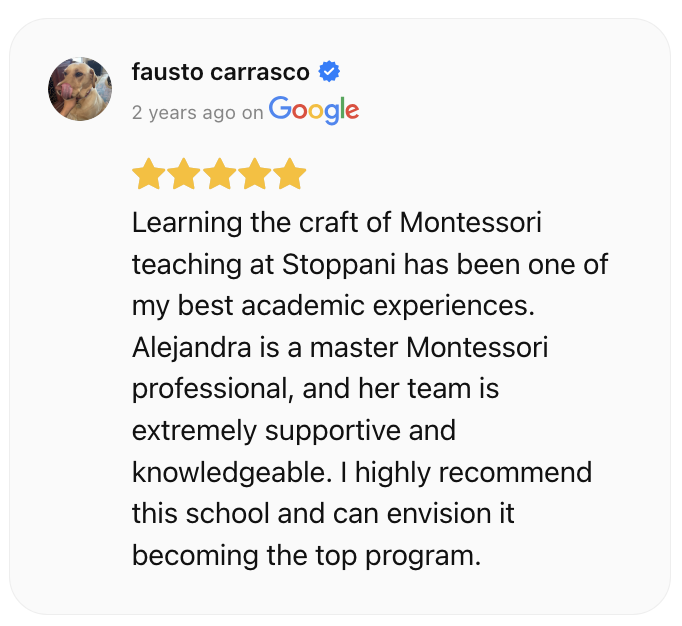
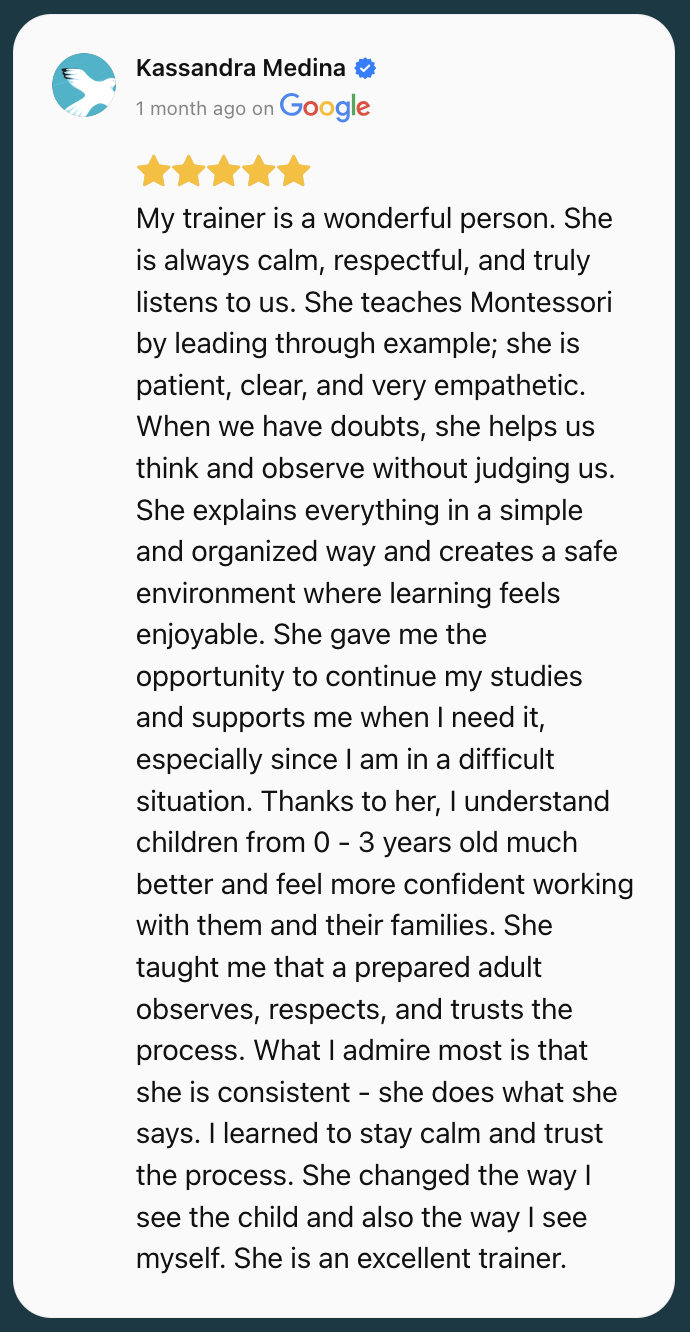
Your trainers are career AMI guides who have spent decades leading Montessori classrooms across several countries, and they teach a demanding, carefully structured curriculum.
You can fit the coursework around a job through online and on-site study, and the diploma's hands-on portion runs over the San Diego summers.
If you are deciding where to train, Montessori Stoppani gives you the genuine AMI route: an internationally recognized, MACTE accredited diploma taught by guides with long classroom careers, available online and on-site and in English or Spanish. The hands-on part of the diploma takes place over two summers in San Diego, and people fly in from around the country and overseas to attend.
The range runs from the Infant (0-3) and Primary (3-6) diploma to the assistant courses and shorter workshops, and every one is built on real classroom work rather than theory alone. Diploma graduates can carry on to a master’s degree through Loyola, and the costs and schedules are there to see right away, not locked behind a long wait.
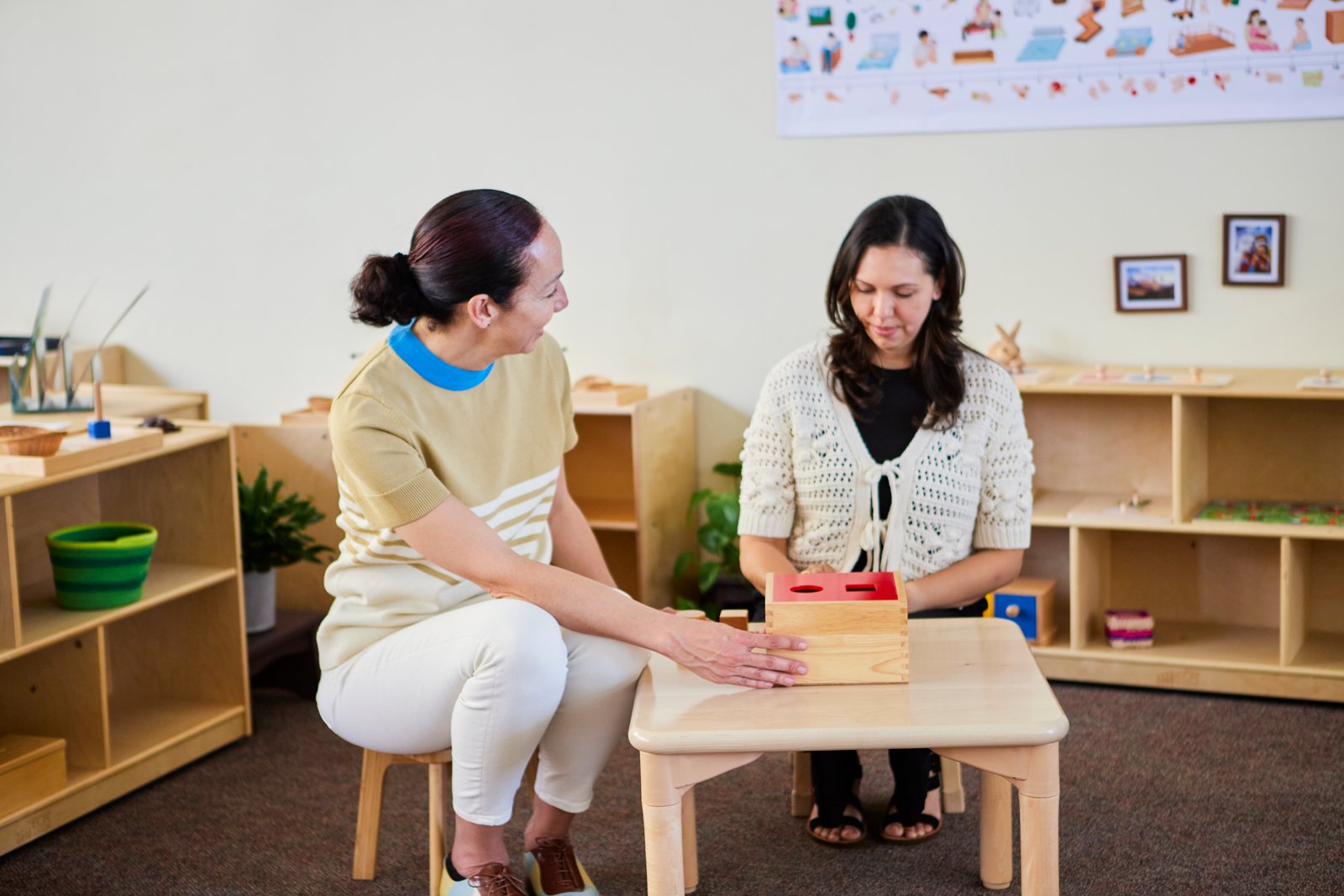
The people who teach here hold AMI trainer status, most with decades in Montessori classrooms around the world.
Alejandra Rosas is an AMI Infant and Nest Community Trainer and Training Director at Montessori Stoppani Institute with more than 25 years of Montessori experience. She received her AMI 3 to 6 diploma in Italy and her 0 to 3 diploma in San Diego under the direction of renowned Montessori educator Dr. Silvana Montanaro. Alejandra has dedicated her career to supporting young children, families, and future Montessori guides through internationally respected AMI training, workshops, consulting, and classroom leadership.

Cristina A. De León holds advanced degrees in Clinical Psychology, Pedagogy, and Education and has more than 25 years of experience working with children in Montessori and traditional educational environments. She received her AMI diplomas in Early Childhood and Elementary Education through the Montessori Institute of San Diego and currently serves as a Casa de Niños AMI Trainer and Examiner. Cristina has guided Montessori educators internationally throughout the United States, Argentina, Costa Rica, Taiwan, and Spain, bringing deep educational experience and a global Montessori perspective to her training work.
Gabriela Velázquez began her Montessori journey at an early age, first as a Montessori student and later as an assistant in the same school where her mother worked as a Montessori guide. She earned a degree in Early Childhood Education, her AMI Nido and Infant Community diploma, and a master’s degree in education before spending more than 20 years working in Montessori schools throughout Mexico and the United States. Today, Gabriela serves internationally as an AMI 0 to 3 trainer, examiner, consultant, and speaker, helping future Montessori guides deepen their understanding of early childhood development.
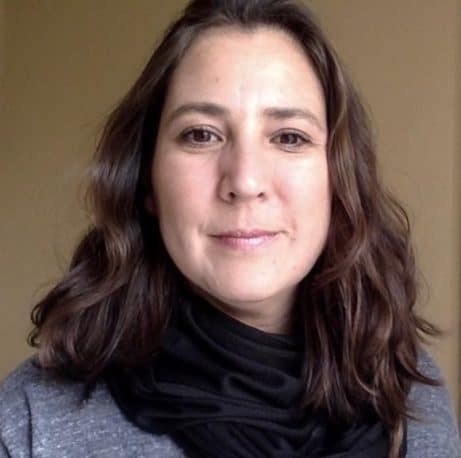
Emily Hansen is an AMI 0 to 3 Trainer with more than 21 years of Montessori classroom experience across Toddler and Primary communities. She holds degrees in Psychology, Sociology, and Montessori Education, along with AMI diplomas at both the 0 to 3 and 3 to 6 levels. Emily combines deep Montessori expertise with a warm and practical approach to education, bringing years of experience supporting children, families, and future Montessori educators through her training work.
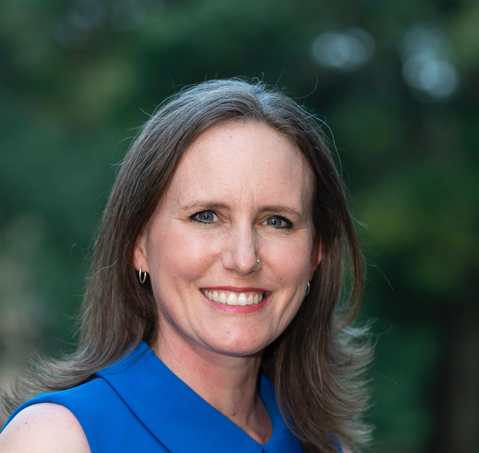
Dr. Mario Salguero is a physician, researcher, and educator specializing in personalized medicine, psychiatry, nutrition, and integrative health. After graduating from the University of Guadalajara School of Medicine, he completed advanced studies in Clinical Nutrition and earned a PhD in Molecular Biology in Medicine before completing his Psychiatry Residency at the University of California, San Diego. Dr. Salguero combines scientific research, medical education, and a compassionate approach to child and human development as part of the Montessori Stoppani training team.


Picking a Montessori teacher training program is a big commitment, so here are direct answers to what applicants ask us most, from accreditation and levels to formats, cost, and enrolling.
It is. The training here is genuinely AMI, and the diploma is MACTE accredited, so Montessori schools worldwide know exactly what it represents when they see it on your resume. It sets you up for a professional career as a certified Montessori teacher.
You have options. The assistant courses run fully online, the diploma blends online study with the in-person summers, and which format applies depends on the program you pick. That flexibility is what lets people keep working while they train.
It varies by program, level, and format, which is why we put the numbers in one place: ask for the program details and pricing guide and the costs come back to you on the spot, not days later by email.
No college credits change hands here. What you earn is a professional AMI teaching credential, which stands on its own; if you want an actual graduate degree, that comes through the Loyola master’s route, and we can walk you through it.
A guide holds the full AMI diploma and runs the classroom, setting up the prepared environment and leading the children’s work, while an assistant is trained to support that guide and keep the environment running day to day. The assistant course is a briefer, lower-commitment option, and the diploma prepares you to take charge of a room of your own.
AMI stands for the Association Montessori Internationale, the body Maria Montessori set up herself to protect how her method is taught. A diploma earned to the AMI standard tells a school you trained the authentic way, which is why hiring teams so often ask for AMI specifically rather than another certification.
The diploma is accredited by both AMI and MACTE, which is what makes it authentic teacher training and a credential a school can rely on. The assistant courses carry AMI recognition rather than that full accreditation, and the workshops are built to the same rigorous Montessori standards.
Yes. Because the diploma is MACTE accredited, graduates can add one more summer and earn a master’s degree through Loyola. The specifics shift from year to year, so ask us for the current details before you count on a particular route.
There is not much to it. Pick the program that suits you, ask for the program details and pricing guide (you see it instantly), and text us with anything you are unsure about before you apply.
AMI and AMS are not the same thing, and for anyone researching Montessori training, that difference is the first thing to settle. AMI, the Association Montessori Internationale, is the organization Maria Montessori founded; AMS is a separate American body with its own standard. The diploma from Montessori Stoppani is a genuine AMI credential, accredited by MACTE, the accreditor recognized for Montessori teacher education, and an AMI diploma is recognized everywhere in the world.
A second point trips people up early: an AMI diploma is a professional Montessori teaching credential earned through the training itself, separate from a state teaching license, which a state issues on its own terms. The guides who lead the courses hold their own AMI diplomas and have taught in classrooms internationally for decades, so you learn the method from people who earned the credential you are pursuing.
The AMI diploma runs as a hybrid: online coursework through the year, plus an in-person portion completed over two summers, with supervised classroom practice as part of the training. That structure is what lets someone train without leaving a current teaching job or relocating for a year. If a full diploma is more than you need right now, the AMI assistant courses are fully online and blended at the 0 to 3 and 3 to 6 levels, and the workshops give parents and schools a lighter way in.
Cost is usually the next question, and here it is not hidden behind a phone call: request the program details and pricing guide and the costs, schedules, formats, and payment options come straight back to you. Courses are taught in English and Spanish, and the program is built to keep an authentic AMI credential financially within reach.
The right starting point depends on the age you want to teach. The Montessori Stoppani diploma certifies you to lead a classroom at the Infant (0 to 3) or Primary (3 to 6) level, while the assistant courses cover those same age bands in a shorter form for people who want to work in a classroom without leading it yet. A practicing teacher usually enrolls straight into the diploma, and a parent or classroom aide often starts with an assistant course before stepping up to the diploma.
Finishing the diploma can also open a Loyola master’s degree pathway, since the program is MACTE accredited, so the credential can become a step toward an advanced degree. Graduates who want to teach locally can use the institute’s own job board, where San Diego and California Montessori schools post openings for AMI-credentialed teachers.
San Diego is where the in-person part of the diploma actually happens. Over two summers, diploma students come together on-site for intensive work, then finish the rest of the coursework online from wherever they live. People fly in from across the country and abroad for those summers, so the program fits local educators in San Diego, Carlsbad, and Encinitas as well as those who cannot find authentic AMI training near home.
Those summers are where trainees work hands-on with the Montessori materials, practice giving lessons, and get direct feedback from the AMI trainers. Anything that shifts by cohort, the dates, the cost, and how to apply, is handled through the program details, or a quick text to the team.